All Glory to Sri Guru and Sri Gauranga
Having returned from travel in India and Thailand on March 17, 2026, and being imbued with transcendental inspiration from all the devotees I had the blessing of associating with, I continue to seek spiritually uplifting ways to engage with the local and broader New Jersey community. With this in mind, there is something unique about NJ that I’ve always been vaguely aware of, but that has recently been capturing my attention more and more: the large Indian-American population.
Out of all 50 states, while New Jersey has the third largest number of Indian citizens, it also has the highest percentage of its population that is Indian. According to Pew Research, of California’s 39.4 million residents, 960,000 (2.4%) are of Indian origin. Of the 32 million people in Texas, 570,000 (1.8%) are Indian, and of the 9.5 million in New Jersey, 440,000 (4.6%) are Indian. The high percentage of Indians in New Jersey is not arbitrary in how the state functions. In February 2024, Governor Phil Murphy passed Executive Order No. 354 establishing the New Jersey-India Commission. This executive order acknowledged that “New Jersey maintains close ties with India culturally and economically, as India is New Jersey’s second-largest foreign direct investor and more New Jersey residents who are immigrants hail from India than from any other country” and “the establishment of a New Jersey-India Commission will enhance New Jersey’s ability to foster trade, investment, and cultural and educational exchanges between India and the State.” The purposes of the commission were defined as:
“(a) advance bilateral trade and investment between New Jersey and India; (b) encourage mutual economic support between New Jersey and India; (c) encourage mutual investment in the infrastructure and economies of New Jersey and India; (d) promote cultural and educational exchanges between New Jersey and India, including in areas of research, science, and technology; (e) study and initiate joint action on policy issues of mutual interest to New Jersey and India; and (f) address similar issues as determined by the Commission.”

The article titled “New Jersey + India: An Innovative Future” further discusses the state’s attempt to nurture its relationship with India. Coupled with the statistic that New Jersey has more scientists and engineers per square mile than any other state, related to the fact that NJ is the most densely populated state in general, there is sufficient reason for thinking that NJ is the perfect place for sharing the value of the Vaishnava’s perspective of the science of consciousness, including how a holistic consciousness-centered worldview can encourage progress in personal and organizational development, and social reformation.
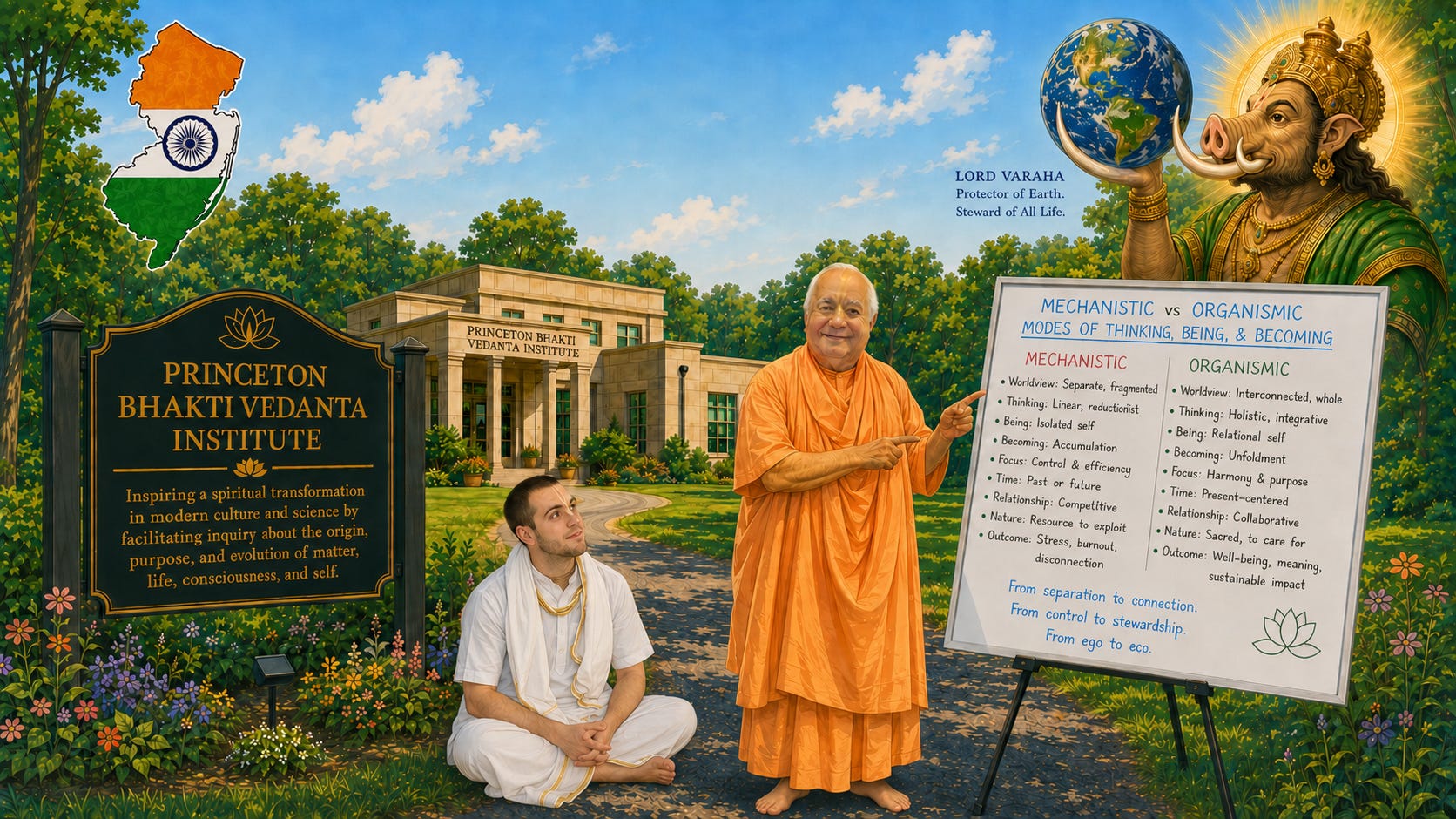
Constantly learning and teaching others about the science of consciousness offered by the Vaishnavas has been what my Guru, Dr. B Madhava Puri (1943-2025), dedicated his life to since the early 1970s. Srila A.C. Bhaktivedanta Swami Prabhupada personally told Dr. Puri to use his background as a PhD in quantum chemistry to show the scientific value of the Vaishnava’s teachings, and specifically to show that matter comes from life (consciousness). Dr. Puri brought this work to New Jersey by opening the Bhakti Vedanta Institute of Spiritual Culture and Science in Princeton, NJ, in 2012. He said, “Many people think of the whole Vedic tradition of India to be a ritualistic, polytheistic religion they call Hinduism; few understand the profound philosophical truths it represents. We’re trying to reclaim and present that core philosophical foundation in a modern way.” The result of his efforts became known as Organic Wholism, derived from Srila Bhakti Rakshak Sridhara Dev-Goswami Maharaj’s use of the phrase “Organic Whole” to describe Krishna, the all-attractive Supreme Personality of Godhead. G.W.F. Hegel also used the phrase “organic whole” to describe the absolute reality.
From 2018 to 2025, Dr. Puri taught me about how Organic Wholism can promote a more compassionate attitude towards the environment and nurture the development of the spiritual dimension of life in education, science, and society. In the blog posts that follow, I will explore the implications of these teachings for modern life to the best of my ability. As I have mentioned previously, I cannot properly digest and assimilate my experiences and lessons learned until I write about them, so blogging about these topics will also be deeply helpful for my own understanding. I sincerely look forward to sharing this process with whoever stumbles upon these posts and finds value in them. While the content is for everyone, regardless of bodily circumstances (gender, ethnicity, nationality, etc), I do hope that the Indian-American community in New Jersey finds my writing of interest, given their generally innate appreciation for Vedic wisdom and its modern relevance.
Organic Wholism deepens discussions of mechanistic and organismic modes of thinking, being, and becoming, in which mechanistic and organismic perspectives are seen as stages on a spectrum of the evolution of consciousness, progressing from states of local competitive interests that fuel collective divisiveness, individual alienation, and a hostile environment, to higher conscious states of universally aligned interests fueling collective harmony/integration, enduring individual fulfillment, and a nurturing environment. In the last conference presentation Dr. Puri gave at Science and Scientist 2024, which was titled “A Conceptual Foundation for Deeper Insights into Living & Nonliving Systems,” essential details characterizing the mechanistic and organismic natures were outlined.
My next series of blog posts will explore existing material on how the mechanistic and organismic frameworks influence organizational and personal development, and how insights from Organic Wholism can enrich these ideas to support human flourishing and spiritual progress.
Sri Krishna Sharanam Mamah